An assistant that remembers the conversation, and goes back to answers that went stale Search finds what looks like your question. A conversation needs what bears on it.
- Most document assistants remember a chat by searching it: they bring back the earlier turns that look like the new question. That misses the turns that matter but look nothing like it.
- VectoGrid puts the whole conversation in front of the model when it plans and when it writes the answer, up to about 25,000 tokens. Past that, the opening and a running summary stand in for the oldest turns, and the summary keeps what you said about yourself.
- In our test with a mid-size open model, a constraint stated once was applied wherever it fell in a 45-turn chat. A passing remark in the middle of the chat was lost. That is a limit we have measured and not fixed.
- Across chats, VectoGrid keeps a short memory of what you say about yourself, kept only with your exact words, which you can see and edit. A constraint stated in Monday's chat is applied in Thursday's new chat, with the date you said it.
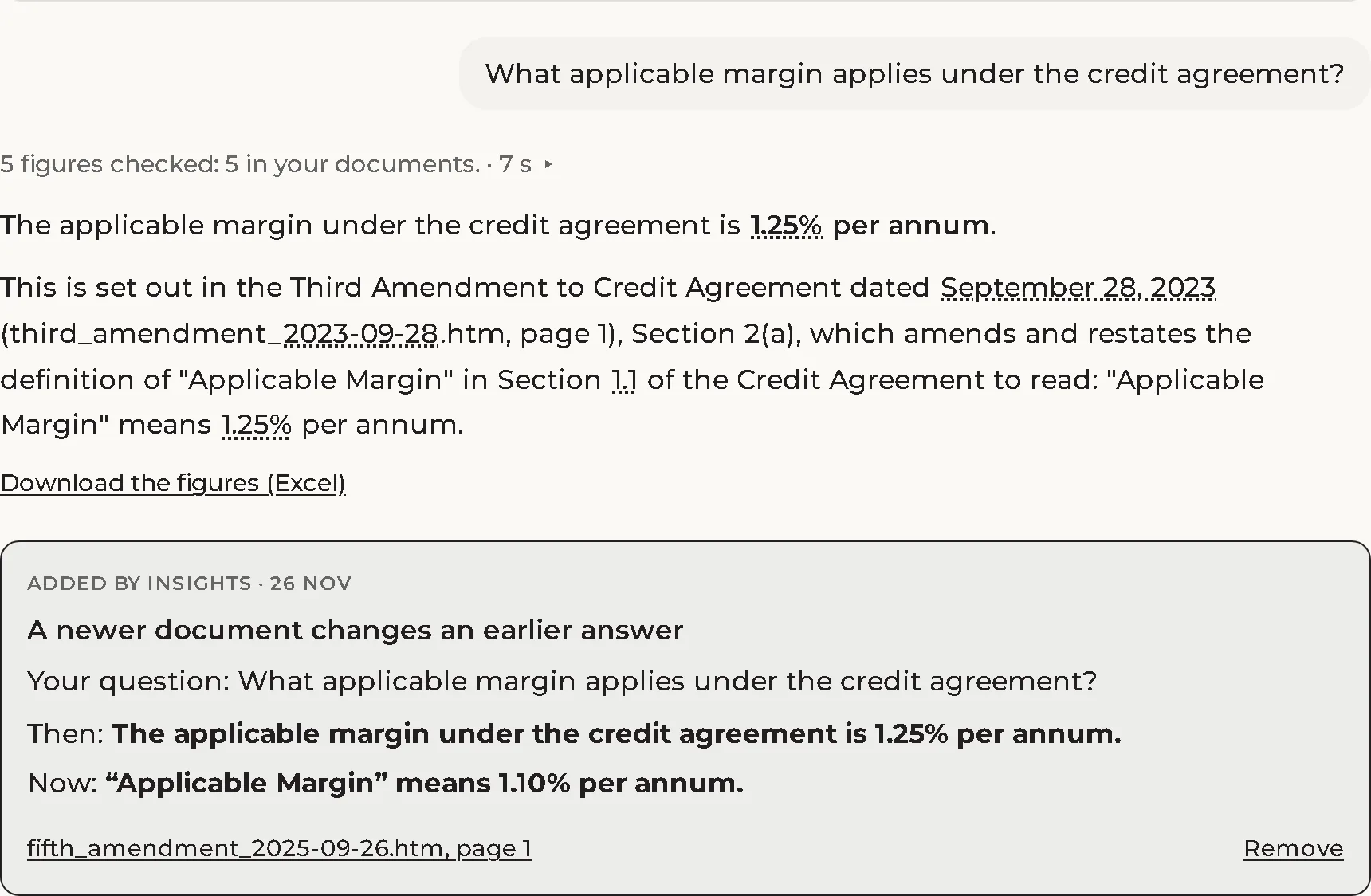
- Answers also go stale when documents change. Insights reads your chats again against the documents added since and flags an answer a newer document changes, or a question it now answers, with the newer document's own words.
Search remembers what is similar. A conversation needs what is relevant.
Picture a long chat. At turn 8 you mention, in passing, that you ate wild mushrooms at lunch. At turn 46 you say you feel a little nauseous. Anyone who had listened would connect the two. A system that remembers by search would not: it compares "nauseous" with every earlier turn, and nothing about mushrooms resembles nausea. The link is not in the words. It is in the reasoning.
The same happens at work. Early in a chat you say that your mandate caps a ratio at three times. Twenty questions later you ask whether a deal fits. The question does not mention the mandate, so a search over the chat does not bring it back, and the answer ignores the one fact that decides it.
Summaries have the opposite weakness. A running summary keeps the gist, but a summary written at turn 10 cannot know which detail will matter at turn 46. Passing remarks are the first thing it drops.
The conversation goes to the model, not a search over it.
VectoGrid keeps three things working together:
- The follow-up is made to stand on its own. "And the second one?" means nothing to a search engine. Before searching, a short call turns it into a full question from the chat so far. A summary of the chat and the earlier turns closest in meaning help with that step. This is the part search is good at.
- The whole transcript goes to the model. What you asked and what we answered, without the passages behind each answer, goes to the agent when it plans its first search and to the step that writes the answer. The model is told to connect anything you said earlier that bears on the new question, and to take facts and figures from the documents only.
- Long chats are condensed from the oldest end. The last turns stay word for word, up to 100,000 characters. Beyond that, the opening question and a running summary stand in for the rest. The summary is written to keep what you said about yourself, your situation and your constraints, because those are what later questions turn on.
The transcript goes to the first step and the last, not to every step in between. An agent resends its context at every step, so a 25,000-token transcript on every step of a long search would multiply the cost (see why an agent's bill grows with the square of its steps). Sent twice, a full transcript adds about five cents to a question at $1 per million input tokens. On a host that discounts repeated input, it costs less.
Constraints are kept. Passing remarks in the middle can be lost.
Before building it, we planted one fact in a 45-turn chat of real questions over company filings, about 22,600 tokens. We moved the fact to turns 3, 8, 25 and 44, then asked a question at the end that the fact should change. The model was the open-weights 27-billion-parameter model we use for answers.
| Planted at turn | 3 | 8 | 25 | 44 |
|---|---|---|---|---|
| A business constraint (a ratio cap in a mandate) | used | used | used | used |
| A passing remark (wild mushrooms at lunch) | connected | missed | missed | connected |
| No fact planted | never invented | |||
The conclusion is plain. With a mid-size open model, a constraint stated once is kept anywhere in a 25,000-token chat. A remark made in passing, in the middle of the chat, can be lost. That matches what is known about long contexts: models read the beginning and the end most closely. Larger models may do better, but we have not measured them. We have no fix for it. We ship it with this limit and tell you about it. To make sure something counts, say it as a constraint ("I must…", "we cannot…"), not in passing.
A short memory of you, with your own words as proof.
Putting every past chat into every question would cost too much and bury the one line that matters. Searching past chats fails for the reason this article opened with. So VectoGrid keeps a short memory instead: what you say about yourself, your situation, your constraints and your preferences. Never facts about your documents, which always come from the documents.
- Learned as you go. While your question is answered, one short call reads only what you typed and picks out what to remember, or which remembered item it updates ("now 4%" retires "3%"). It is kept only if your exact words for it are found in what you typed. The answer says what it remembered, with a link to forget it at once.
- Given to every answer. What is remembered heads the conversation the model reads, in a new chat too, each item with the date you said it. When an answer uses one, it says so: "as you told me on 26 Nov".
- Yours to see and change. A Memory panel lists each item with its date, the chat it came from and your words. You can reword it, keep it to the folder of chats it was said in, or forget it. A switch in Settings turns it off.
In our end-to-end test, a limit stated in one chat ("our board will not accept a rate above 1.20%") was applied in a new chat: "No, it does not fit. Your board's limit, as you told me on 26 Nov, is 1.20%." A passing remark about wild mushrooms at lunch, made in one chat, was connected to "I feel nauseous" in another. One run each, so read it as a demonstration, not a measurement. Insights, below, works across chats too, in the other direction: it checks old answers against new documents.
An answer that was right in March can be wrong in September.
Memory is not only about what you said. It is also about what we said. A rate answered from an amendment was correct the day it was given. Then a later amendment changed it, and the old answer sits in the chat history, still looking right. Nobody asks the question again, because they think they already know.
Insights goes back. It reads your earlier answers against the documents added since each one and raises two kinds of finding:
- A newer document changes an answer. The answer relied on a document that a later one replaces or amends, and the later document's own words give a different value for something the answer said.
- A newer document answers a question. The answer said the documents did not have it, and a document added since does.
How it works, step by step
Insights does not ask your questions again. Rerunning every question against every new document would cost as much as asking them all again, and a second answer worded differently is not proof that anything changed. It works from two things VectoGrid already keeps:
- Every answer records its sources. Each figure in an answer is checked against the passage it came from when the answer is written, so we know which documents each answer relied on.
- Every document records what it changes. When a document is read, VectoGrid works out whether it is a new version of another document or an amendment to one, and when it arrived. This is the same work that powers the version history of your documents.
With those, a run goes like this:
- Find the answers worth checking, for free. It goes through the answers in all your chats, newest first. It keeps an answer only if a document it relied on has a newer version or amendment that arrived after the answer, or if the answer said your documents did not have what you asked and new documents have arrived since. Most answers do not qualify, and no model is called for this step.
- Check each one with one short call. A small, fast model reads the question, the old answer and the figures it used, what the newer document says it changes, and the few passages of the newer document that best match the question. It replies with the old value, the new value and the words that say so. That costs a fraction of a cent, and up to sixteen checks run at once, always behind any question someone is asking.
- Keep only what can be proved. A wrong alert costs more than a missed one: after two false alarms, nobody reads the third. So the quoted words must be found exactly in the newer document. The new value must be in those words, and the old value in the old answer. The two must differ. Anything short of that is dropped. A document that changes something the answer never mentioned raises nothing. So does the same value stated again.
- Never check the same pair twice. Each answer and newer document pair is checked once, whatever the result, and remembered.
When it runs
After each upload, as soon as the new documents have been read and their versions worked out. Documents dropped together are checked together. Because only answers touched by a newer document are checked, a run is usually a handful of checks. A safety cap of 200 a run keeps a large upload from running away, and anything left over is picked up later the same day.
It has its own line in the cost panel, so you can see what it costs. It runs on your own model and key when you have set one, otherwise on ours. You can switch it off in Settings or on the cost panel.
Where it goes
New findings wait in the Insights panel. Helpful adds the finding to the chat it came from, in a bordered box like the one above. It also becomes part of that chat's history, so later answers there use the new value. Dismiss sets it aside. Every finding, dismissed ones too, is also kept in a chat of its own, called Insights, where it can be searched like any other chat or asked about.
What this says, and what it does not.
- The planted test: one 45-turn chat of real questions over public company filings, about 22,600 tokens, one run per position, an open-weights 27B model on a fast host, 26 November 2026. Read it as a direction, not a benchmark.
- The end-to-end tests run the real service: documents uploaded, questions asked, newer documents added, insights read, and the quotes checked against the documents.
- The five-cent figure is arithmetic: 25,000 tokens sent twice at about $1 per million input tokens, with no discount for repeated input.
For answers with every source published, see VectoGrid scores 90% on FinanceBench.
Does your assistant know an answer it gave has gone stale?
Published 26 November 2026 · Philippe Vergnet, VectoGrid